
Start a small business by defining a customer and offer, checking the costs and requirements that apply to your activity, and organizing the next action you can actually complete. Use the editable workflow below to keep evidence, unanswered questions and responsible people together. A completed planning sheet is a working record, not permission to trade or proof that a business will succeed.
This guide is for a small US operation at the planning stage. It does not prescribe a legal structure, promise a launch date or replace advice about your state, industry, taxes or insurance. If you are outside the United States, use the planning questions but replace the official references with your own authorities. Resolve requirements before undertaking an activity that needs permission.
Define the first customer and a bounded offer
Write a sentence naming who you intend to serve, the problem you can help with and what you will deliver. For example, a freelance designer might offer one menu layout to an independent restaurant, with a stated number of revisions. This is a fictional illustration, not evidence that restaurants will buy the service. A narrow offer makes it easier to ask useful questions and estimate the work.
Separate your ability to perform a task from evidence that someone wants to pay for it. Ask potential customers about a recent occasion when the problem occurred, what they did and what made the workaround inconvenient. Record their account without turning it into a sales forecast. If you still have only an idea, work through our business idea test before committing to equipment or a large product build.
Choose an initial delivery boundary: one customer type, one deliverable and one way to reach those customers. Write down what is excluded. The point is to expose assumptions early. It is usually easier to reconsider a one-page offer than to unwind a lease or a large order placed before you understand the work.
Keep planning and launch checks connected
The SBA counseling hub groups business resources into planning, launch, management and growth. Its launch links include location, structure, naming, registration, tax IDs, permits, banking and insurance. Use those topics as prompts to investigate. Their appearance on a list does not tell you which filing, policy or approval your particular business needs.
Our diagram organizes that investigation into three workstreams. They overlap: a location requirement may change costs, and an unaffordable cost may change the offer. Do not read the arrows as a rule that customer research must finish before you can ask a local office about a permit.
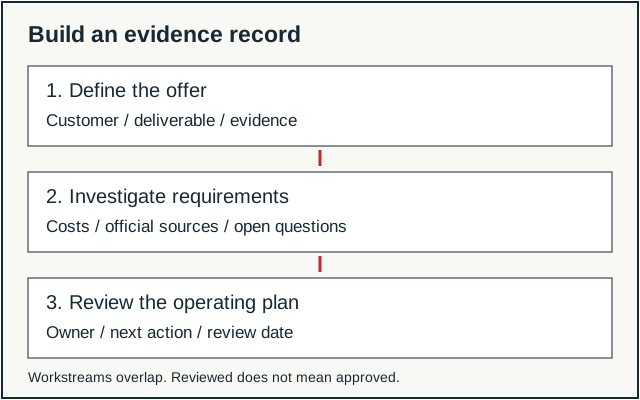
The workflow tool records a status for each workstream. “Reviewed” means you have reviewed that topic and saved the relevant evidence. It does not mean an agency approved your business. “Unresolved” stays visible until you have a specific answer. Use the notes field to name the next question, who can answer it and when you will check again.
Sketch costs before you commit cash
List the items you expect to pay for once and the costs you expect to recur. For a home-based service, those might include equipment, software, supplies and professional advice. For a physical location, the list could be very different. Get quotes or current official fees where appropriate; a number copied from another founder is only a lead to investigate.
Keep household money and available business funding visible in separate records. This article does not calculate how much you can safely risk. Decide your own spending boundary with appropriate advice, and do not treat hoped-for sales as cash already available. If an essential cost remains unknown, record the missing quote instead of inserting zero to make the plan look affordable.
A fictional example: one operator has three unresolved cost questions about materials, workspace and insurance. The useful next move is to obtain those answers. Buying a website theme does not resolve them. For a service with known delivery capacity, the site's service pricing calculator can help explore explicit assumptions; its output still cannot establish demand or guaranteed income.
Check structure, tax and local requirements
The IRS checklist for starting a business identifies basic federal tax topics, says the checklist is not exhaustive, and notes additional state requirements. It includes selecting a business structure and tax year, an EIN where applicable, business taxes and employee forms where relevant. Use its links to investigate your circumstances rather than assuming every item applies in the same way to every operator.
Record where the business will operate and what it will actually do. A useful question for an authority names the activity and location: for example, whether a proposed home workshop needs a local approval. “Do I need a business license?” may be too broad to produce a complete answer. Save the official page or written reply, the date and any limits in the answer.
Do not select a structure solely because an online checklist calls it popular. Note ownership, liability, tax and administrative questions for a qualified adviser. Likewise, a federal tax identifier does not by itself answer state registration, local permission or industry requirements. Treat each unresolved requirement as a separate task with its own source and evidence.
Prepare a small operating plan
Describe what happens from an inquiry to delivery: how you agree scope, communicate price, handle payment, provide the work and keep records. Test the sequence with a fictional order before you promise it to a customer. If you need insurance, banking, contracts, data handling or specialist permissions, investigate those before the activity they affect. The workflow is an organizing aid and cannot decide those requirements for you.
For a first delivery, name the person responsible for every step even if every name is yours. Include an exception route for work you cannot perform or an order you cannot accept. A clear boundary gives you something to explain to a potential customer and something to revise when an assumption proves wrong.
Avoid collecting sensitive customer information merely to make a planning exercise look realistic. Use invented names and sample records while testing the process. Keep confidential details out of the downloadable workflow if the file will be shared. This tool runs in your browser and does not save your entries to a server; export a copy if you want to retain them after leaving the page.
Review the next action rather than declare victory
At the review point, read the evidence beside each topic. A reviewed offer with no customer evidence still needs investigation. A quote without a date may need refreshing. A note saying “ask the city” is a useful reminder, but it is not a verified answer. Set the next action to resolve the most consequential uncertainty you can address.
The tool counts reviewed workstreams solely to help you find incomplete records. Three reviewed topics do not produce a launch-ready score. Its output always retains the warning that legal, tax and operational requirements need their own confirmation. If your plan changes location, activity, ownership or staffing, revisit the affected evidence instead of keeping a reassuring old status.
For help beyond this memo, SBA's counseling hub describes free or low-cost counseling and directs readers to local resource partners. Bring a concise offer description, your unresolved questions and the sources already checked. That gives the conversation a concrete starting point while leaving the adviser room to identify issues your list missed.